The rivalry between the house of Representatives (DPR) and the Corruption Eradication Commission (KPK) recently is quite serious has caught the public’s attention. DPR was outraged because the KPK interrogated four leaders of the DPR’s Budgetary Body (Banggar): Melchias Markus Mekeng, Tamsil Linrung, olly, and Mirwan Amir. The four leaders of Banggar were being questioned about the mechanisms related to the Revised State Annual Budget (APBn-P).
 The leaders of the Budgetary Body had then refused to continue the process of discussions of the budget and submitted it to the DPR leadership. The Budgetary Body presented a letter numbered 118/BA/DPRRI/IX/2011 dated 21 September 2011 to the leadership of DPR containing the return of the mandate of budget discussions by Banggar to the DPR leaders.
There have been too many data, and it is a common knowledge that the budget for these mafia networks involve three groups of actors in the institutions of the state: the members of DPR, who are mainly located in Banggar; networks at the agency / ministry (executive) governing tenders of government projects; and companies that are partners in the government projects. These three actors do not meet directly, but are linked by the budget brokers. Thus, the mode of political corruption of is executed in neat systemic networks.
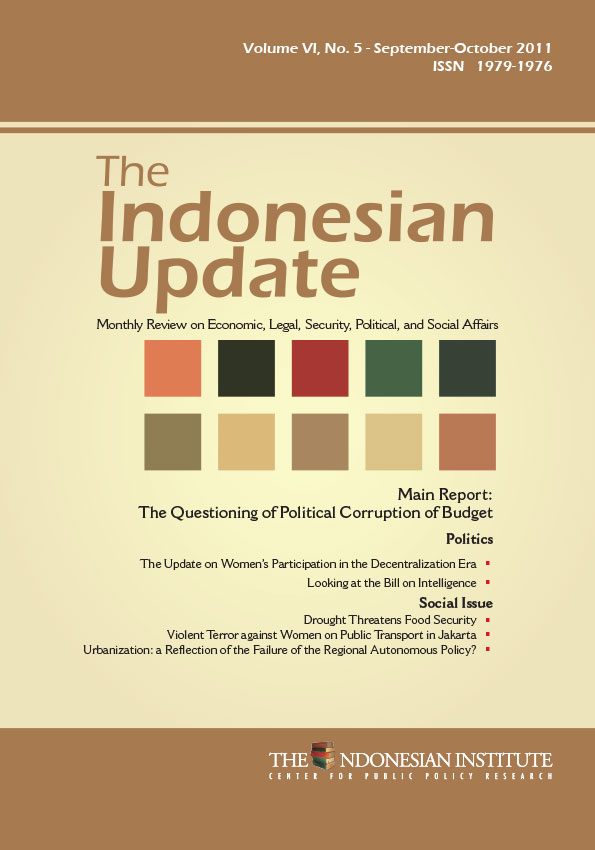
This edition of the Indonesian Update raises a main theme on the budget corruption. It also raises several important themes in the political and social fields. on political affairs, it discusses the Intelligence Bill and also women’s participation in the decentralization era. on social affairs, it talks about the drought that threatens food security and also about the violence against women on public transportation. Another social theme is urbanization: a sign of the failure of regional autonomy.
The regular publication of the Indonesian Update with its actual themes is expected to help policy makers in the government and the business sector, academicians, and international think tanks get actual information and contextual analyses on economic, political, social, and cultural developments in Indonesia.
Happy reading!
 Loading...

 Reload document
 Open in new tab